How it works
One compact device in the car — no wires to your phone, no reflashing, no service visits. Here's the entire path your data takes.
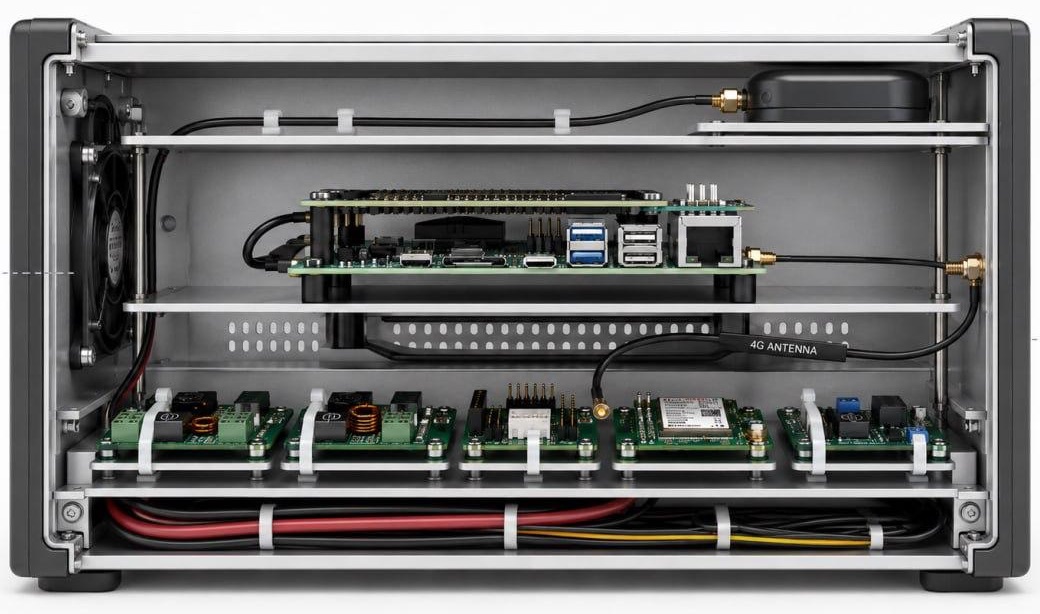
This is a reference build shown for clarity. The production device may differ in layout and components — but the three-level architecture (power → compute → antennas) and active cooling stay the same.
Inside the CarStream Unit
Built like an instrument, not a DIY kit: three levels in a plastic enclosure with its own power and cooling. Hover a level to take a closer look.
Three steps — and the car is online
The compact device lives in the trunk or the glovebox. It's powered by a regular car charger. The adapter plugs into the diagnostic port under the steering wheel — every car made after 2001 has one.
Open CarStream on your phone — it finds the new device nearby on its own and links it to your account. No Wi-Fi passwords, no configs, no 40-page manuals.
Everything else is automatic: trips land in the log by themselves, statistics add up, cameras get announced. The dashboard opens from any browser or phone.
Tunnel, village, mountains — nothing is lost
When the connection drops, the Unit quietly remembers every second of the drive. As soon as the network returns, everything syncs by itself — and the trip shows up in the log as if the connection never went away.
The questions people ask before buying
Didn't find yours? Write to us — we answer fast.
Contact →Yes, if your car was made after 2001 (diesel — after 2004) — it has the standard diagnostic port. European and Asian cars from the last 10–15 years provide the richest data.
No. The device only reads data — it never writes to the car's systems. It's powered from the charging socket, so with the ignition off it doesn't draw from the battery.
Yes, the Unit goes online through its own SIM — a regular plan with a few gigabytes per month is more than enough. The owner's phone is not involved at all.
Only you. Every car is tied to your account, and the only things that become public are the links you create yourself — showing exactly the data visible in them.
Yes. Add as many cars as you like and switch between them in one tap; each keeps its own history, statistics and rules.
No. All features are available right after buying the device. The only recurring cost is your mobile plan for the SIM card.